Nucleic Acid Synthesis
The synthesis of nucleic acids in-vitro is the foundation of modern nucleic acid medicine, enabling the mass development of novel therapies for cancers and genetic diseases. We offer a wide range of quality reagents and consumables to support high-purity oligonucleotide synthesis using the standard phosphoramidite method.
The Phosphoramidite Process
The phosphoramidite method is widely considered to be the gold standard technique for the synthesis of oligonucleotides and involves the sequential addition of a phosphoramidite monomer to a solid-phase support, with each cycle adding a nucleotide until the desired strand length is reached.
This cycle consists of four steps: deblocking/detritylation, coupling/activation, capping, and oxidation/sulphurisation.
We provide a broad range of ancillary reagents for each step of the synthesis process, including phosphoramidite compounds.

Solid Supports
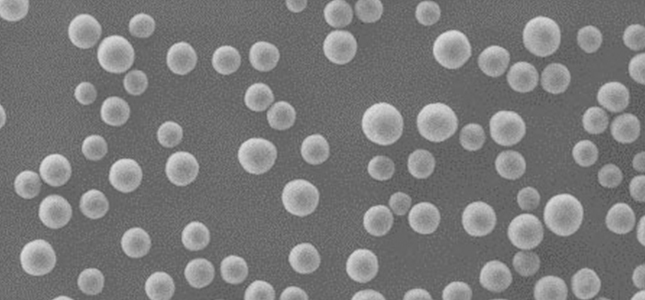
Solid supports are the insoluble particles on which the oligonucleotide is bound to during solid-phase synthesis. The Aminolinker range of highly cross-linked polystyrene supports deliver high purity, coupling efficiency and reagent washing efficiency, while minimising volume change and damage during synthesis.
These are supplemented by the PT Linker range of phenanthrene-type universal linkers, which can be freely conjugated to the solid support and enable the single, underivatised support to be used irrespective of the sequence of the oligonucleotide to be synthesised.
High lipophilicity and UV-detectability allow the targeted oligonucleotide to be easily separated from linker-derived impurities.
Image: SEM image of Aminolinker PS resin
1. Deblocking/Detritylation
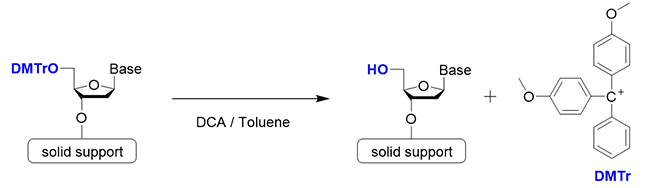
Detritylation, also known as deblocking, involves the removal of the 4,4’-Dimethoxytrityl (DMTr) group protecting the 5'-hydroxy group of the 5'-terminal base at the beginning of each synthesis cycle. As the trityl cation is stabilised by two methoxy groups, it can be easily cleaved by treatment with a weak acid, such as dichloroacetic or trichloroacetic acid.
2. Coupling/Activation
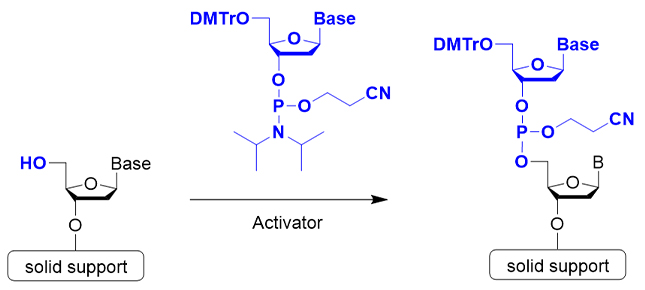
During the coupling reaction, condensation occurs between the nucleoside phosphoramidite unit to be bound and the nucleoside on the solid support (first cycle) or the oligonucleotide being synthesised (subsequent cycles).
The nucleoside phosphoramidite monomer is first mixed with an activator, protonating the diisopropylamino group and enabling the formation of a support-bound phosphite triester linkage.
3. Capping
As 100% reaction efficiency between the support-bound nucleoside and the incoming phosphoramidite is not possible, there will be a few unreacted hydroxy groups remaining at the end of the cycle. If these are not dealt with, they will instead react with the incoming phosphoramidite in the next cycle, resulting in an incomplete oligonucleotide with one less base, equivalent to a deletion mutation.
As a result, a capping step is performed, with the 5'-OH group of the unreacted strand acetylated to prevent any further reaction.

4. Oxidation/Sulphurisation
The phosphite triester linkage formed during the coupling step is slightly unstable and may cause undesirable side reactions during further synthesis cycles. To prevent this it is converted into a stable phosphate triester through iodine oxidation in the presence of water and a weak base such as pyridine.
In the synthesis of oligonucleotide phosphorothioates, the oxygen atom in the phosphate moiety is replaced with sulphur – in these cases, the oxidation step is replaced with a sulphurisation step, which instead occurs prior to capping.

Chemical Phosphorylation Reagent
5′-monophosphorylated oligonucleotides, which have strong applications for nucleic acid functionalisation and ligation reactions, are synthesised by introducing a monophosphate group at the 5'-end of oligonucleotides. Chemical phosphorylation reagents (CPRs) present an effective alternative to the traditional enzymatic method of phosphorylation, avoiding the challenges of variable efficiency from high substrate specificity.
This innovative CPR introduces a hydrophobic nitrobenzyl tag which enables efficient oligonucleotide purification and separation by reverse-phase HPLC. The reagent demonstrates a coupling efficiency of up to 99% and uses the same principle as DMT-ON purification for significantly improved purity.
This CPR therefore demonstrates key benefits for use in the development of novel mRNA therapeutics, such as cancer vaccines and genetic disease treatments.

Nucleic Acid Purification
During the synthesis of oligonucleotides, the 4,4′-Dimethoxytrityl (DMTr) group at the 5′ end can be removed or retained, dictating the choice of purification process. Retention of the DMTr group allows for efficient removal of impurities by solid-phase extraction (SPE) – after cleaving from the solid support, unreacted nucleic acid fragments are removed by passing the solution through the solid-phase column, retaining only fragments with a DMTr group. SPE is therefore frequently employed as a straightforward and efficient purification technique in oligonucleotide synthesis.
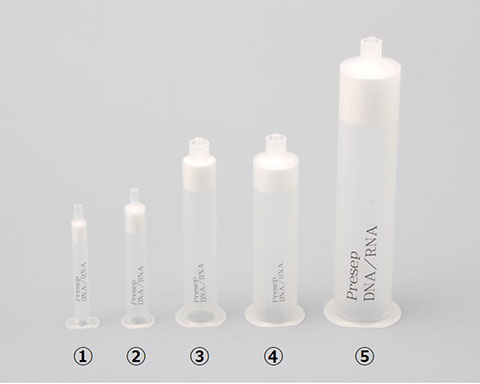
Presep® DNA/RNA are SPE columns specifically designed for the high purity separation and purification of nucleic acids, achieving superior deprotection efficiency and a 3-5 times greater sample load compared to other commercially available pre-treatment columns.
Wakosil®-DNA
When the DMTr group is removed, the oligonucleotide is cleaved from the solid support, deprotected, and then separated from impurities and purified using high-performance liquid chromatography (HPLC). Wakopak® Wakosil®-DNA is a dedicated column designed for the analysis and fractionation of oligonucleotides, demonstrating efficient analysis and fractionation of synthetic ssDNA up to several tens of mer for each 1 mer difference.