Rapid Sterility Testing
Sterility testing is a fundamental technique for confirming the absence of microorganisms in products and medical devices, ensuring that patients are kept safe from harmful pathogens.
Applications

Traditional sterility testing techniques are slow, often requiring significant amounts time for incubation and substantially delaying the lead time of the tested product. This has prompted the need to develop rapid, alternative sterility testing methods that greatly improve turnaround time without compromising accuracy.
The RiboNAT™ Rapid Sterility Test is designed to meet this need, accurately detecting a wide range of bacteria in just 7 hours – a fraction of the time of a standard test.
The full test assay consists of three kits, sold separately –
RNA Isolation Kit 1, RNA Isolation Kit 2 and a Detection Kit.
Benefits
One day rapid sterility test (approximately 7 hours)
Wide detection range includes both bacteria (aerobic and anaerobic) and fungi, in a single assay
95.7% coverage of bacteria and 92.3% coverage of fungi (in silico)
Higher sensitivity than standard NAT methods
Reduced false positives from dead microorganisms and residual DNA

Background
Current compendial sterility testing has an incubation time of 14 days, up to 28 days for mycoplasma testing, strongly limiting effective application of important drugs and therapies to patients. Demand for a shorter turnaround time for sterility testing is high, particularly regarding medicines with a short shelf life, many of which may even expire before the standard test finishes. This includes a growing number of life-saving novel cell and gene therapies which are fundamentally incompatible with compendial membrane filtration sterility testing.
The Nucleic Acid Amplification Test (NAT) method is one alternative technique that has been used to avoid this problem, preventing the need for lengthy culture and reducing the time required to a single-day test. Nonetheless, there are widely recognised limitations of the standard NAT method, including false positives caused by residual DNA and dead microorganisms and difficulty detecting a sufficiently wide range of microorganisms to properly assess a sample.
RiboNAT™ Performance
While standard NAT methods detect genomic DNA, RiboNAT™ counteracts many of these downsides by targeting ribosomal RNA (rRNA) using RT-rPCR. As rRNA can be found in higher relative quantities in microorganisms than genomic DNA, this improves the sensitivity of the assay.
RiboNAT™ additionally minimises false positives by inactivating DNA from dead microorganisms and degrading residual DNA with DNase.
Due to these advantages, RiboNAT™ is able to provide the accuracy of standard sterility testing methods, with a lightning-fast turnaround of just 7 hours, allowing administration of the treatment to the patient safely and reliably just days after completing production.

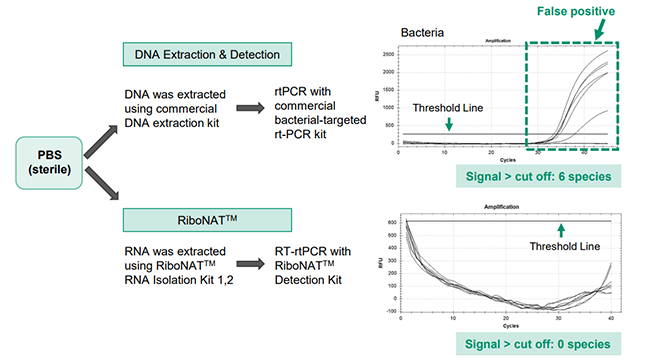
The RiboNAT™ Rapid Sterility Test method was assessed against traditional DNA sterility testing for the detection of false positives – a sterile sample of commercially available PBS was tested for 6 microorganisms (A. brasiliensis, B. subtilis spizizenii, C. albicans, C. sporogenes, P. aeruginosa, S. aureus) using both tests.
While six amplification curves were observed in the DNA-based test, no amplification occurred in the RiboNAT™ test.